REVIEW · PARIS
Normandy Omaha, Utah Landing Beaches Small-group Trip from Paris
Book on Viator →Operated by Clewel Travel · Bookable on Viator
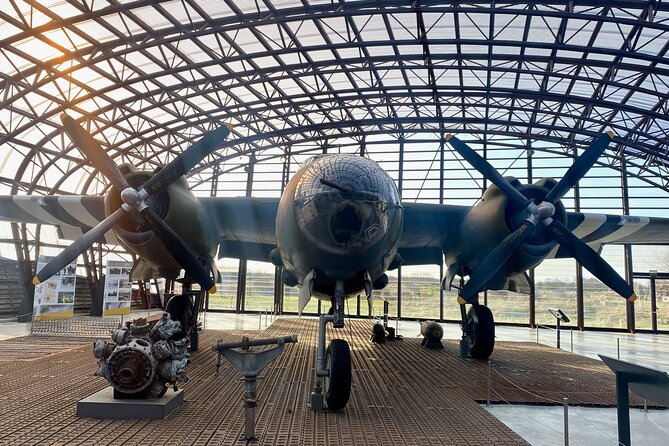
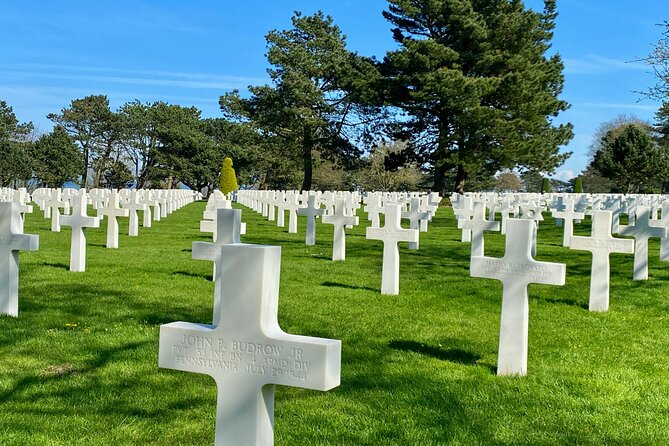
The original B26 bomber at Utah Beach Landing Museum is one of only six left in existence, but the most moving part of this day comes at the Normandy American Cemetery. Looking across the rows of white crosses toward Omaha Beach, you get a direct sense of the cost of D-Day.
I like the small maximum group of seven, which makes the long drive from Paris less tiring than a full coach. I also like the hotel or Airbnb pickup, plus the chance to see three major landing sites and two museums in one demanding day. The drawback is clear: you spend about seven and a half hours on the road, so the stops can feel rushed.
In This Review
- Key points to know before booking
- The real shape of this Normandy day trip
- Overlord Museum: a useful first lesson
- Normandy American Cemetery: the day’s most powerful stop
- Omaha Beach: seeing the scale of the landing
- Pointe du Hoc: bunkers, cliffs, and the Rangers’ assault
- Utah Beach: a different story from Omaha
- Utah Beach Landing Museum and the B26 bomber
- Small-group comfort versus a larger coach
- Is $419.94 a fair price?
- Who should book this experience?
- Final call: a strong overview with a fast pace
- FAQ
- How long is the Normandy tour from Paris?
- Where does pickup take place?
- How many people can join the tour?
- What type of vehicle is used?
- Is the tour guided in English?
- Which D-Day beaches are included?
- Which museums are included?
- Is the Normandy American Cemetery included?
- Is food included?
- Can I cancel for a full refund?
Key points to know before booking
- Three major D-Day sites in one day: Omaha Beach, Utah Beach, and Pointe du Hoc give you a broad view of the American landings.
- The American Cemetery is the emotional center: You see 9,387 graves, the Wall of the Missing, memorial maps, and the small visitor museum.
- A rare B26 bomber awaits at Utah Beach: The landing museum was built over a former German bunker.
- Small-group transport matters: The tour uses a Mercedes E220 or Mercedes minivan, with no more than seven people.
- Expect a very long day: Pickup is at 7:30 am, return is scheduled for about 8:30 pm, and meals are not included.
- The guide experience can vary: Live guiding is included from four people, and past feedback praises David by name, along with an energetic driver-guide who allowed a flexible pace.
The real shape of this Normandy day trip
This is not a leisurely country outing from Paris. It is a concentrated 13-hour history day with roughly 280 kilometers to Normandy and another 370 kilometers back to Paris. You leave at 7:30 am and return around 8:30 pm, usually with one rest-area stop on the way out.
That sounds intense because it is. Still, the route makes sense if you have only one available day for the D-Day beaches. You visit the principal American sites without arranging trains, rental cars, parking, or complicated local connections.
The vehicle is a Mercedes E220 business-class car for a very small party, or a Mercedes minivan when the group is larger. The maximum group is seven. That is a useful middle ground: more personal than a coach, but less expensive than arranging a fully private vehicle for a larger family or party.
You receive bottled water, but meals and drinks are not included. Bring food for the day, or plan to buy something during a stop if time allows. With so much time in the vehicle and only short windows at some sites, a little preparation will make the day easier.
You can also read our reviews of more tours and experiences in Paris.



Overlord Museum: a useful first lesson
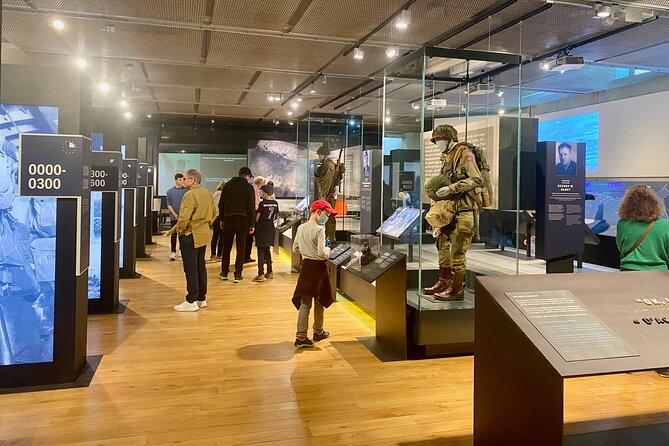
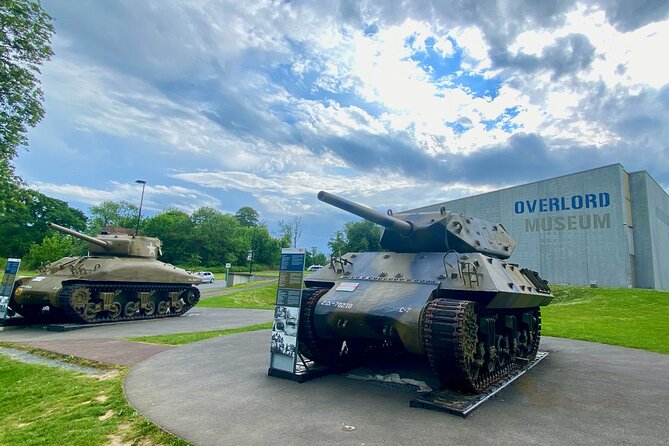
The first scheduled stop is the Overlord Museum, a few hundred meters from the American Cemetery. You have about 30 minutes here, with admission included.
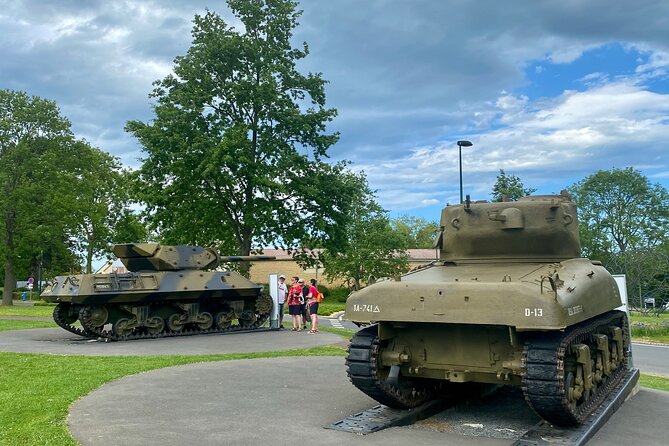
The museum holds World War II artifacts, tanks, guns, military vehicles, a V-1 missile, and personal belongings. Its strength is variety. Instead of asking you to understand the invasion through maps alone, it puts machinery and individual objects in front of you.
Thirty minutes is enough for an introduction, not a full museum visit. You will need to keep moving. If military hardware is your main interest, you may want more time here than the schedule permits. If you are using the museum to prepare for the cemetery and beaches, the short visit gives you useful context before the more reflective stops.
This is also where the small-group format helps. A large coach group can take time to unload and regroup. A car or minivan gets you close to the next stop quickly, though the overall schedule remains tight.
Normandy American Cemetery: the day’s most powerful stop
From the Overlord Museum, you travel a few minutes to the Normandy American Cemetery in Colleville-sur-Mer. You have about one hour here, including the visitor center.
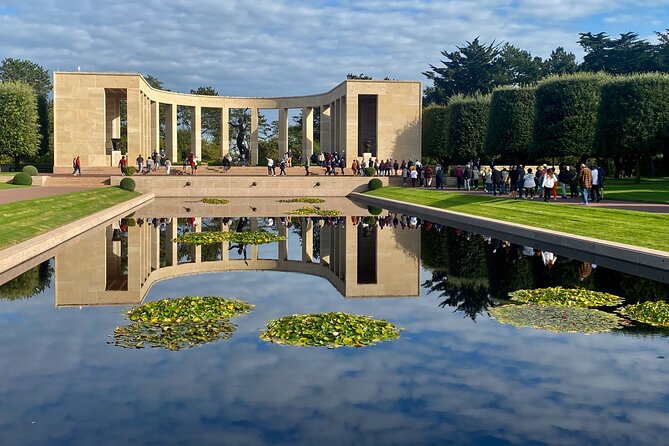
The cemetery contains 9,387 American service members, most killed during the Normandy landings. The Wall of the Missing lists 1,557 names. Rows of graves stretch across carefully maintained grounds above Omaha Beach, and the view toward the sea gives the memorial a powerful setting without needing much explanation.
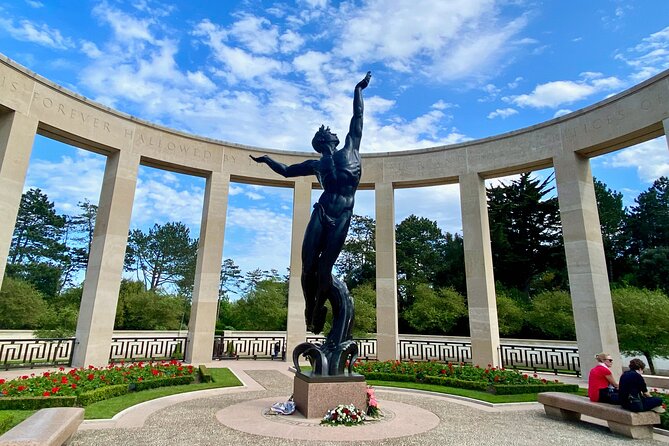
You will see the semicircular memorial colonnade, the sculpture Spirit of American Youth Rising from the Waves, and large maps showing the military operations. The visitor center has a small museum with information about the Battle of Normandy.
I would treat this hour as the emotional core of the tour. Do not spend every minute indoors. Leave enough time to walk among the graves, read some names, and look down toward the shore. The cliffs below still contain remains of German defenses, including concrete casemates with memorials.
The schedule gives you admission to the cemetery and visitor center, but the depth of interpretation depends on the guide and on how much time you spend reading. One past assessment praised David as an attentive guide and recommended him specifically. Another praised an energetic driver-guide who explained the sites while allowing the group to move at its own pace. The listed service says live guiding is provided from four people, so confirm how guiding will work for your particular group size.
Omaha Beach: seeing the scale of the landing
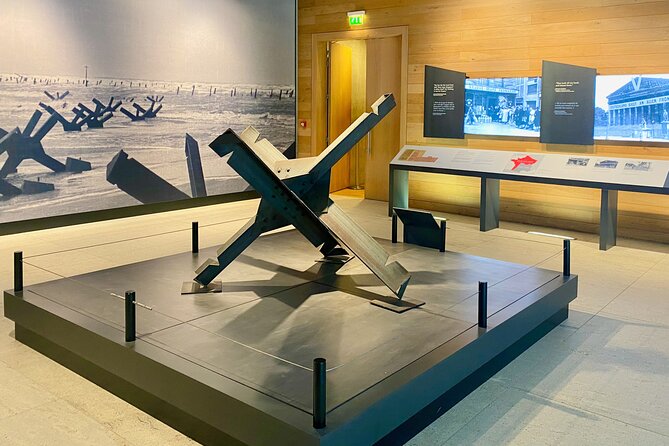
Omaha Beach is only about 10 minutes from the cemetery. The visit lasts about 30 minutes.
The beach is the best-known of the D-Day landing areas, and the tour focuses on the sacrifice of the approximately 34,000 men who landed here on June 6, 1944. The beach itself is broad and open. That physical openness can be surprising after reading about the obstacles faced by the soldiers approaching it.
Thirty minutes gives you time to take in the shoreline and the Omaha Beach Memorial Signal, but not to explore every memorial or historical detail. This is a stop for orientation and reflection rather than a long museum visit.
You should also expect the emotional weight of Omaha to build on what you have just seen at the cemetery. The sequence is well chosen: first the graves, then the beach where so many of those buried there were killed. It makes the history personal without requiring a long lecture.
Pointe du Hoc: bunkers, cliffs, and the Rangers’ assault
About 15 minutes later, you reach Pointe du Hoc for roughly 50 minutes. This headland sits between Omaha and Utah Beaches and was important because guns positioned there could fire toward both landing areas.
The site formed part of Hitler’s Atlantic Wall defenses. Concrete casemates, gun pits, and other fortifications remain, and a monument to the 2nd Ranger Battalion sits on top of the fire-control casemate. You can walk among the damaged defenses and see how difficult the position was to attack.
This is one of the most visual parts of the day. The uneven ground and surviving bunkers show the scale of the German defenses more clearly than a display case can. The tour’s description specifically highlights the 2nd Ranger Battalion’s sacrifice in taking the battery on June 6, 1944.
Give yourself time to look carefully at the fortifications rather than simply taking a photograph and returning to the vehicle. Fifty minutes is workable, but you should stay aware of the departure time. The schedule does not allow for a long independent walk.
Pointe du Hoc is also a good test of your preferred touring style. If you want a slow, detailed visit at every site, this itinerary will frustrate you. If you want to see the major positions in one day and accept short visits, it delivers a lot.





Utah Beach: a different story from Omaha
The drive from Pointe du Hoc to Utah Beach takes about 40 minutes. You have about 30 minutes at the beach itself, followed by one hour at the Utah Beach Landing Museum.
Utah was the westernmost of the five Normandy landing beaches. Around 23,000 American soldiers came ashore here on June 6, 1944, with comparatively light casualties of 197, including 60 missing. The operation involved units including the 4th Infantry Division, the 82nd and 101st Airborne Divisions, VII Corps, the 90th Infantry Division, the 4th Cavalry Regiment, and the 70th Tank Battalion.
The contrast with Omaha matters. Seeing both beaches helps you understand that D-Day was not one identical assault repeated along the coast. Each site had different objectives, defenses, units, and casualty figures.
At Utah Beach, you have free time to look around before entering the museum. Thirty minutes is enough to stand at the shore and read memorials, but it is not enough for a slow exploration of the many monuments and museums in the area. The stop works best if you have already decided that your main goal is the beach itself and the landing museum.
Utah Beach Landing Museum and the B26 bomber
The final Normandy stop is the Utah Beach Landing Museum, open for about one hour. It was created in a former German bunker, which gives the building its own historical presence before you even reach the exhibits.
Inside, you will find historical artifacts and military vehicles, along with an original B26 bomber. Only six of these aircraft remain in existence, making this a particularly unusual object in a day already full of military history.
The museum is a strong finish because it adds machinery and exhibits after several outdoor memorials. It also helps tie together the military operation you have been tracing from beach to beach. Admission is included.
You should still keep an eye on the clock. The return drive is scheduled to take about four hours, with arrival in Paris around 8:30 pm. Staying longer at the museum is not practical unless the driver changes the plan, and the tour is built around returning to Paris that evening.
Small-group comfort versus a larger coach
The small vehicle is one of the strongest reasons to choose this experience. You avoid a full bus, and the Mercedes E220 or minivan should make the long road portions more comfortable. A small group also means less time collecting people at each stop.
The company states that vehicles can save up to 30 percent of travel time compared with large buses, partly because coaches are limited to lower highway speeds. That does not turn the day into a relaxed outing, but it explains how the tour fits five major stops into a single day.
The tradeoff is that a larger group can sometimes provide a more formal, detailed presentation. One past assessment felt rushed and thought a larger group might have offered more detail for less money. That is a fair criticism. Small group does not automatically mean better historical interpretation.
Ask before departure who will guide your group. From four participants, live guiding is included. A past assessment names David as a recommended guide, but you should not assume he will lead every departure. The driver may also serve as guide, depending on the group arrangement.
Is $419.94 a fair price?
At $419.94 per person, this is not a budget excursion. The cost includes transportation from Paris, the professional driver, bottled water, the Normandy American Cemetery, Overlord Museum, and Utah Beach Landing Museum. You are paying for a full day of vehicle service and the convenience of reaching several sites that are difficult to combine without a car.
The value is strongest for a small party that wants a direct pickup and does not want to rent a car. It also makes sense if this is your only chance to see Normandy from Paris. You save the time and effort of planning roads, parking, museum opening arrangements, and the return journey.
The value is weaker if you prefer slow museum visits or want the lowest possible cost. You pay a premium for the compact vehicle and efficient routing, but you still spend much of the day driving. The short stop at the Overlord Museum and the half-hour visits at Omaha and Utah Beaches may leave history fans wanting more.
Think of the price as paying for access and simplicity, not maximum time at each location.
Who should book this experience?
I would recommend it to you if you have one free day in Paris, want to see the major American D-Day sites, and value hotel pickup over independent planning. It is especially suitable for couples, families, and small parties who would rather share a Mercedes than board a large coach.
It also suits visitors who want a broad first look at Normandy. You get museums, beaches, bunkers, graves, military maps, vehicles, and memorials in one carefully packed day.
I would hesitate if you want a detailed military study. The schedule gives you an overview, but not the time for every museum room, memorial, and fortification. The past 3-star assessment is useful here: the guide was considerate, but the pace left some details uncovered.
The activity is offered in English. Pickup is advertised from your hotel entrance or Airbnb address at 7:30 am, while the listed meeting point is 10 Place de l’Opéra. Confirm the exact pickup arrangement before the morning of departure. Free cancellation is available if you cancel at least 24 hours before the start time. Changes or cancellations inside that window are not accepted for a refund.
Final call: a strong overview with a fast pace
Book this Normandy day trip if your priority is seeing the essential American D-Day sites from Paris without driving yourself. The American Cemetery, Pointe du Hoc, and the rare B26 bomber give the day real weight, and the small vehicle is a practical advantage.
Skip it if you need long, unhurried visits or the lowest price. For most first-time visitors with only one day, though, this is a sensible and moving introduction to Normandy. Pack food, wear comfortable shoes, prepare for a long return ride, and accept that the breadth of the route comes at the cost of time.
FAQ
How long is the Normandy tour from Paris?
The experience lasts approximately 13 hours. Pickup is scheduled for 7:30 am, with return to Paris around 8:30 pm.
Where does pickup take place?
Pickup is offered at your hotel entrance or Airbnb address at 7:30 am. The listed meeting point is 10 Place de l’Opéra in Paris, so confirm the exact arrangement when booking.
How many people can join the tour?
The maximum group size is seven people.
What type of vehicle is used?
For smaller parties, the tour uses a Mercedes E220 or E300 business-class car. A Mercedes minivan is used for larger groups, with the exact vehicle depending on group size.
Is the tour guided in English?
Yes. The experience is offered in English. Live guiding is included from four participants.
Which D-Day beaches are included?
The tour visits Omaha Beach and Utah Beach. It also visits Pointe du Hoc, which is located between the two beaches.
Which museums are included?
Admission is included for the Overlord Museum near Omaha Beach and the Utah Beach Landing Museum.
Is the Normandy American Cemetery included?
Yes. The tour includes the Normandy American Cemetery and its visitor center in Colleville-sur-Mer.
Is food included?
No. Meals and drinks are not included. Bottled water is provided.
Can I cancel for a full refund?
Yes, if you cancel at least 24 hours before the experience begins. Cancellations or changes made less than 24 hours in advance are not accepted for a refund.