REVIEW · MONTPELLIER
Montpellier City Exploration Game and Tour on your Phone
Book on Viator →Operated by Wanderway · Bookable on Viator
Montpellier’s historic center is made for wandering, and this phone-based game gives your walk a clear shape. You move from grand Place de la Comédie through medieval lanes, Saint-Roch Church, Saint-Pierre Cathedral, the Arc de Triomphe, and the royal Promenade du Peyrou.
I like the freedom to stop and restart whenever you want, and I like the low $9.67 price for a private activity. The quizzes add a little purpose to the walk, while the pop-up map and monument notes help you notice places you might otherwise pass. The tradeoff is the app itself: some users found map links buggy, and a few puzzles did not match the location closely enough.
In This Review
- Key points to know before you book
- What kind of Montpellier experience is this?
- Starting near La Tour de la Babote
- Place de la Comédie, Montpellier’s grand opening scene
- Saint-Roch Church and the older center
- Rue du Bras de Fer, a medieval street with modern life
- Saint-Pierre Cathedral and the city’s church architecture
- The Court of Appeal and Second Empire grandeur
- The Arc de Triomphe and royal symbolism
- Promenade du Peyrou and the route’s grand finish
- How well do the quizzes and maps work?
- Price, languages, and overall value
- Who should book this phone tour?
- Should you book the Montpellier exploration game?
- FAQ
- Where does the Montpellier phone tour start?
- Where does the activity end?
- How long does the experience take?
- Is a personal guide included?
- Is this an audio tour?
- Which languages are available?
- Are entrance tickets included?
- Can I cancel for a full refund?
Key points to know before you book
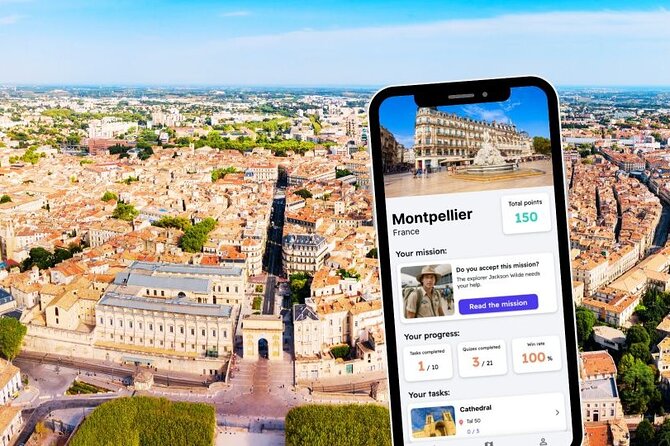
- A self-guided route through central Montpellier: Begin at La Tour de la Babote and visit seven major sights, ending back at the meeting point.
- A flexible two-to-three-hour walk: You control the pace, with about 15 minutes suggested at each stop.
- Quizzes, hints, and monument notes: The activity adds simple challenges to the sightseeing rather than supplying a standard audio tour.
- No personal guide and no audio: You need your own phone, and the experience depends on reading the app.
- Good value at $9.67: The price is modest for a private activity, especially for couples or small groups who want their own schedule.
- Useful, but not flawless technology: Map and navigation glitches have affected some users, particularly on iOS.
What kind of Montpellier experience is this?
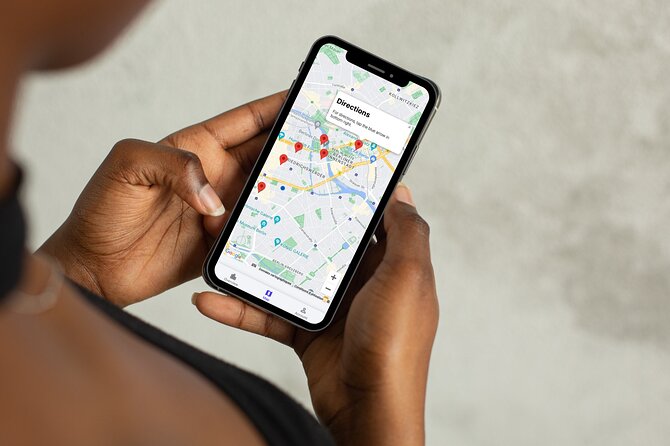
This is a self-guided city game, not a guided walking tour. You meet at La Tour de la Babote, at 17 Bd de l’Observatoire, then use an Android or iOS app, or your browser, to work through the route.
The activity combines short explanations with quiz questions and hints. That format can make a familiar sightseeing walk feel more active. Instead of simply reading a plaque or taking a photo, you may be asked to look closely at a building or answer a question connected to the stop.
You should also know what it does not provide. There is no personal guide, and it is not an audio tour. If you want lively storytelling, spontaneous recommendations, or someone to explain Montpellier’s past as you walk, this will feel thin. If you prefer privacy and an easy pace, the format makes good sense.
The listed duration is about two to three hours. Seven stops are planned at roughly 15 minutes each, but the full time includes walking, reading, solving questions, and finding each point. You can pause for a coffee, take photos, or continue later, which is one of the strongest reasons to choose this format.
The activity is private, so only your group takes part. That matters if you dislike joining a large group or want to set your own rhythm.
You can also read our reviews of more city tours in Montpellier


Starting near La Tour de la Babote
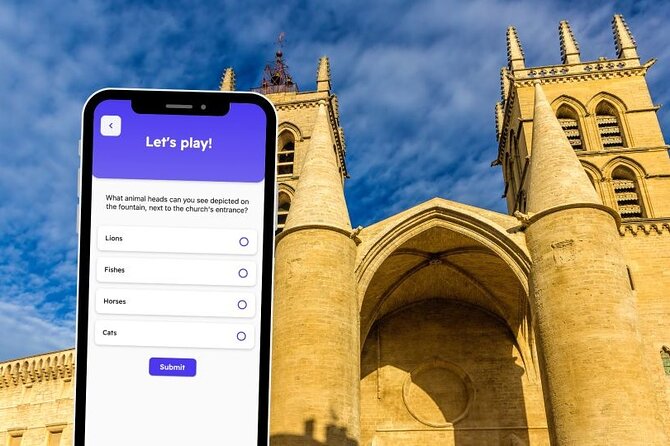
La Tour de la Babote is the stated meeting point, at 17 Bd de l’Observatoire. The route then takes you through the central sights of Montpellier, with Place de la Comédie included as the first listed stop.
The exact practical flow depends on the phone directions. That is worth keeping in mind because one reported problem sent a participant to the wrong place, and some users had trouble opening maps from the app. Before setting off, make sure your phone has enough battery and that you understand how to move between the activity and your map application.
The operating schedule is unusually broad: Monday through Sunday, from midnight until 11:30 p.m., for the stated booking period of June 23, 2024, through February 7, 2027. In ordinary terms, you have considerable freedom to choose your starting time, but the app and booking confirmation should be your final check before you go.
Place de la Comédie, Montpellier’s grand opening scene
Place de la Comédie is the natural attention-grabber on this walk. The broad square is framed by elegant 19th-century buildings with neoclassical façades, including the Opéra Comédie.
Plan to spend about 15 minutes here. The value of the app is not simply telling you that the square is important. A prompt or quiz can encourage you to look up at the architecture and notice the relationship between the opera house and the surrounding buildings.
This is also a good place to get your bearings. It gives you a sense of Montpellier’s grand civic face before the route turns toward smaller streets and older religious buildings. The drawback is that the square can feel more like a major city center than an intimate historic corner, so the appeal comes mainly from its scale and architecture.
The stop is free. You do not need an entrance ticket for the square, though the activity does not include entry to any monument that charges admission.
Saint-Roch Church and the older center
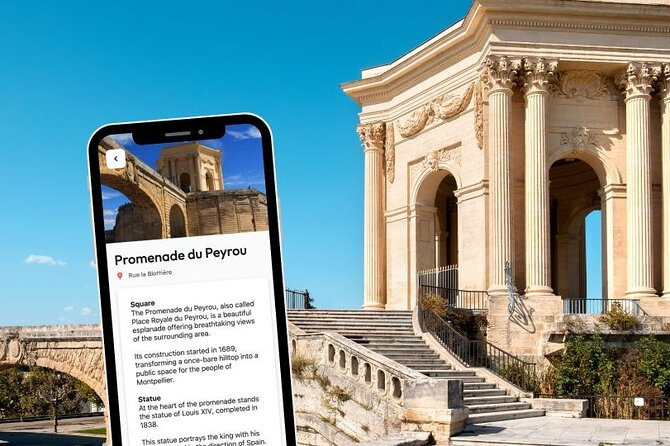
The Church of Saint Roch sits in Montpellier’s historic center. Construction began in the late 13th century, and the church dates back to the 14th century.
The planned time here is about 15 minutes. This is the kind of stop where the short notes matter because the building’s age and setting can be easy to miss during a casual walk. The route gives you a reason to pause and connect the church with the older part of the city.
Admission is not included. The supplied information does not state an entrance fee, so you should not assume that the activity covers access inside. Treat this stop primarily as an exterior visit unless you confirm opening arrangements separately.
The church also helps break up the architectural rhythm of the tour. After a large public square, you move toward a place of worship and a more concentrated historic setting. That change gives the walk some variety.
Rue du Bras de Fer, a medieval street with modern life
Rue du Bras de Fer has medieval roots, but its present character comes from the mix of artisan shops, boutiques, cafés, and galleries.
Allow around 15 minutes. This is less about one grand monument and more about street-level Montpellier. You get a chance to notice the shape of the lane, the small businesses, and the way an old street continues to function as part of daily city life.
The stop is free, and you do not need an admission ticket. I especially like this kind of place in a city walk because it keeps the experience from becoming a chain of formal buildings. The app’s quiz can help you pay attention to details instead of rushing through to the next major sight.
The limitation is that commercial streets change. Shops and cafés may differ from what a description suggests, and the experience here depends more on your own curiosity than on a single landmark. Consider the stop a short neighborhood walk, not a scheduled shopping session.
A few more Montpellier tours and experiences worth a look

Saint-Pierre Cathedral and the city’s church architecture
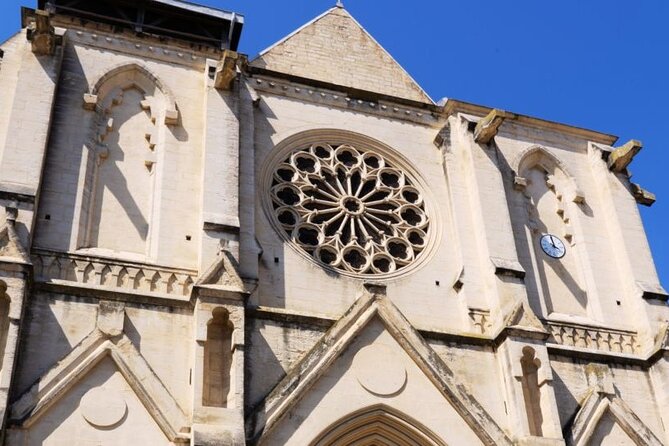
Saint Peter’s Cathedral has a history reaching back to the 14th century, with origins linked to an earlier 11th-century church. It is one of the tour’s most substantial religious landmarks.
The suggested visit lasts about 15 minutes. The cathedral gives the activity a stronger architectural focus than Rue du Bras de Fer, and the notes can help you place the building within Montpellier’s long development.
Admission is not included. The information provided does not give a ticket price or guarantee interior access, so check separately if entering the cathedral is important to you. Even if you only view it from outside, it remains a key stop in the central historic district.
This is also where a self-guided format may feel limited. A live guide could point out smaller details, explain changes to the building, or answer questions on the spot. The phone activity instead gives you a short explanation and a quiz, which is useful but less flexible.
The Court of Appeal and Second Empire grandeur

The Court of Appeal, or Palais de Justice, dates from 1856 to 1865. Architect Jean Giral designed it in the Second Empire style, known for grand scale and classical elements.
Spend about 15 minutes here. The building adds a civic and legal note to the route, showing that Montpellier’s identity is not only medieval lanes and churches. Its architectural style also contrasts with the older religious sites.
Admission is free for this stop. You will be viewing the exterior, since a court building is not presented here as a visitor attraction with included entry.
This is a useful stop for anyone interested in how European cities layer different periods beside one another. The app’s quiz format may work well here if it directs your eye toward symmetry, classical decoration, or the building’s date. If the question is too general, as has happened at some stops, you may get less from it than from simply looking carefully.
The Arc de Triomphe and royal symbolism
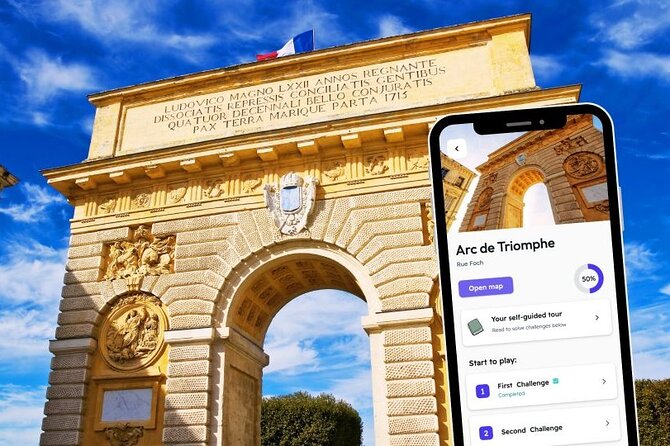
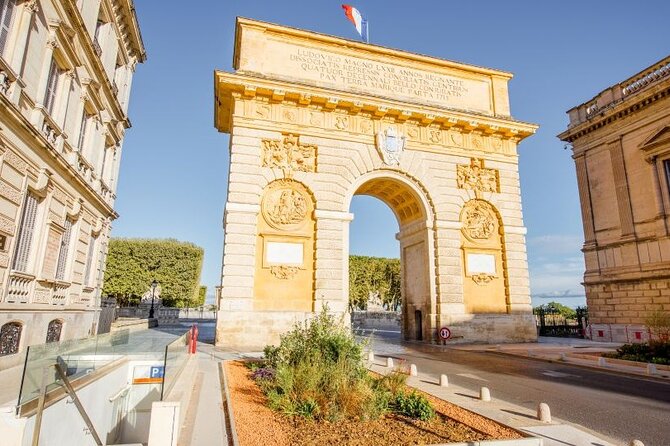
Montpellier’s Arc de Triomphe was built in the late 17th century. King Louis XIV commissioned it to mark the conquest of Franche-Comté.
The stop is planned for about 15 minutes and is free. It offers a clear example of how royal power was expressed through city monuments. The arch is not merely a decorative gateway. Its purpose was political, linking the city to the ambitions and victories of Louis XIV.
This is one of the places where a short historical note can add real value. Without context, you may see an attractive arch and move on. With the background, you can read it as a statement about monarchy and military success.
Do not expect the app to turn the stop into a full history lecture. The format favors brief information and questions. That keeps the pace moving, but anyone wanting a detailed account of Louis XIV’s campaigns will need another source.
Promenade du Peyrou and the route’s grand finish
The Promenade du Peyrou was created in the late 17th century under Louis XIV. It was designed as a grand promenade and a symbol of royal power, with views over Montpellier.
Allow about 15 minutes, though you may want longer if the setting appeals to you. This is the route’s broadest public space and a fitting place to finish the sightseeing portion. After narrow streets, churches, and formal civic buildings, the promenade gives you room to pause and take in the city.
The site is free. The app can supply the historical frame, while you decide how much time to spend looking, photographing, or simply resting.
The stated end point is back at the meeting point, so do not assume the activity finishes wherever the final monument appears. Follow the app’s instructions for returning. Since navigation has been the main weakness reported by users, this is a place to check the route carefully before walking on.
How well do the quizzes and maps work?
The strongest part of the activity is the combination of a pop-up map, short descriptions, and hints. It is simple enough to use without a guide, and the questions can lead you toward details you might not seek out by yourself.
The quality is not perfectly consistent. Some questions are general rather than answerable from the exact spot, and one puzzle reportedly used Roman numerals incorrectly. That matters if you expect a carefully designed scavenger hunt with every question tied tightly to its location.
The app has also had technical trouble. Map links have sometimes been difficult to open, especially on iOS, and one stop directed someone to an incorrect place. These are not dealbreakers for a relaxed city walk, but they can interrupt the experience.
I would treat the game as a helpful layer over your own map rather than your only navigation tool. Keep the route details available, and be ready to open a standard map separately. The activity works best when you see the puzzles as light prompts, not as a demanding competition.
Price, languages, and overall value
At $9.67 per person, this is inexpensive for a private city activity lasting about two to three hours. The price is especially fair if two or more people share the experience and want to avoid a fixed group schedule.
You are paying for access to the phone activity, monument information, quizzes, hints, and route guidance. You are not paying for a live guide, an audio track, or entry tickets. That distinction is important because the low price reflects a self-guided product rather than a shortened version of a traditional guided tour.
The activity is offered in English, French, German, and Spanish. The tour summary lists English, but the included language information gives you four choices within the app. Select your language carefully when booking or starting the activity.
The published score is 3.8 out of 5 from five ratings. That fits the product’s profile: strong flexibility and useful basic information, balanced by technical issues and uneven puzzle design.
Who should book this phone tour?
I would recommend it for independent visitors who want a planned walk without being tied to a guide. It also suits couples, families, and friends who enjoy answering questions together and choosing when to stop.
It is a practical choice if:
- You want to explore alone or with only your own group.
- You prefer a flexible start time.
- You want basic historical context without a long lecture.
- You like quizzes and light scavenger-hunt elements.
- You are watching your budget.
- You are comfortable using a phone for maps and reading.
I would think twice if your priority is expert storytelling, reliable turn-by-turn directions, or a fully polished game. The absence of audio means you will spend time looking at your screen, and the reported map problems can be frustrating if you depend on the app for every turn.
Service animals are allowed, the meeting point is near public transportation, and most people can participate. Free cancellation is available up to 24 hours before the start time for a full refund. Changes or cancellations inside that 24-hour window are not accepted and are not refunded.
Should you book the Montpellier exploration game?
Book it if you want a low-cost, private way to see Montpellier’s main central sights at your own pace. The route covers a good mix: grand Place de la Comédie, old religious buildings, a medieval street, Second Empire civic architecture, a royal arch, and the Promenade du Peyrou.
Skip it if you want a human guide or dependable technology above all else. My practical advice is to bring a charged phone, use the app for its facts and quizzes, and keep a separate map available. With that small backup plan, the flexibility and price make this a sensible introduction to Montpellier.
FAQ
Where does the Montpellier phone tour start?
It starts at La Tour de la Babote, located at 17 Bd de l’Observatoire, 34000 Montpellier, France.
Where does the activity end?
The activity ends back at the meeting point.
How long does the experience take?
The expected duration is approximately two to three hours. Each of the seven listed stops has an estimated visit time of about 15 minutes.
Is a personal guide included?
No. This is a self-guided activity accessed through your smartphone, and no personal guide is included.
Is this an audio tour?
No. The experience is not an audio tour. It provides quizzes, hints, map features, and written information about the monuments.
Which languages are available?
The activity is available in English, French, German, and Spanish.
Are entrance tickets included?
No. Entrance tickets to monuments are not included. Several outdoor stops are free, while Saint-Roch Church and Saint-Pierre Cathedral are marked as not included for admission.
Can I cancel for a full refund?
Yes. You can cancel at least 24 hours before the experience start time for a full refund. Cancellations or changes made less than 24 hours before the start time are not refunded or accepted.