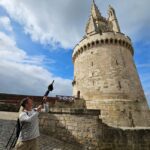
REVIEW · LA ROCHELLE
Guided tour of La Rochelle The splendor of merchants in the 18th century
Book on Viator →Operated by Epok'Tour · Bookable on Viator
La Rochelle’s old port opens a story that is both glamorous and troubling: the 18th-century fortunes of local merchants were tied to sugar from Santo Domingo and the triangular trade. Suzanne Van Hoogwerff, played by a costumed guide, leads you through that world as the daughter of a merchant who knows its manners, ambitions, and secrets.
I like the strong personal viewpoint. Instead of hearing a broad lecture about La Rochelle, you follow one fictionalized merchant family through business, marriage, social life, and financial collapse. I also like the route’s excellent use of historic streets and buildings, including arcades, private mansions, the Chamber of Commerce courtyard, the cathedral, and Hôtel Fleuriau.
The main consideration is the subject itself. This is not a light costume stroll about pretty architecture. Sugar wealth, slavery, and the slave revolt that caused bankruptcies are central to the story, so you should expect a serious account alongside the period drama.
In This Review
- Key points to know before booking
- Why Suzanne’s story works in La Rochelle
- Starting at the Vieux Port and the sugar trade
- From merchant courtyards to arcaded streets
- The Intendance and cathedral in the middle of the route
- Ending at Hôtel Fleuriau and the New World Museum
- What the $15.21 price gives you
- Who should book this walking tour?
- Booking, timing, and cancellation
- Should you book Suzanne’s La Rochelle tour?
- FAQ
- Where does the tour begin?
- Where does the tour end?
- How long does the experience last?
- What places are included on the route?
- What is the main subject of the tour?
- Is the tour suitable for children?
- How many people can join the tour?
- Is a mobile ticket available?
- Can I cancel for a full refund?
Key points to know before booking
- Suzanne Van Hoogwerff leads the story: You follow a merchant’s daughter rather than a modern guide giving a detached overview.
- The old port explains the money: The first 20 minutes connect La Rochelle’s waterfront to 18th-century triangular trade and sugar from Santo Domingo.
- Historic buildings shape the route: Arcaded streets, merchant mansions, the Intendance, the cathedral, and Hôtel Fleuriau all help place the story in the city.
- The tour lasts about 1 hour 45 minutes: That gives enough time for a developed story without turning the walk into a full-day commitment.
- The ending reaches Hôtel Fleuriau: The visit finishes in the courtyard of the current New World Museum at 10 Rue Fleuriau.
- The price is modest: At $15.21 per person, the tour offers a focused history walk at a cost that works well for a first introduction to La Rochelle.
Why Suzanne’s story works in La Rochelle
The smartest choice here is the guide’s identity. Suzanne is not presented simply as an expert listing dates and names. She is the daughter of a merchant, raised inside the privileged world you are trying to understand.
That viewpoint lets the tour cover ordinary details that a standard port history can miss. You hear about family meetings, small social gatherings, entertainment, women’s roles, and the careful social strategies needed to enter elite circles. These subjects show how wealth operated in daily life, not just how it appeared on a balance sheet.
The story also gives the walk a clear shape. You begin with merchant success and social polish, then learn how that world depended on sugar production in Santo Domingo. The final turn toward revolt, bankruptcy, and the fall of Suzanne’s family keeps the tour from treating merchant wealth as a charming old costume.
I find that balance important. La Rochelle’s grand facades can make the 18th century look neat and prosperous. Suzanne’s account adds the harder questions: who gained from this system, who suffered, and how quickly a fortune could disappear when political and economic conditions changed.
The guide’s costume should help younger participants follow the story, but the themes are not only for children. The tour is designed for adults and children over eight, with a maximum of 25 people. That age limit makes sense because the walk deals with slavery, revolt, and bankruptcy as well as manners and entertainment.
You can also read our reviews of more guided tours in La Rochelle


Starting at the Vieux Port and the sugar trade
The meeting point is at 42 Quai Duperré, beside La Rochelle’s Vieux Port. The first section lasts about 20 minutes and is free of admission charges because it takes place around the port.
This is a useful starting point. The old port is not just a scenic place to gather before the real tour begins. It gives Suzanne a natural setting for explaining triangular trade in the 18th century and the connection between La Rochelle’s merchants and Santo Domingo’s sugar.
You can expect the port segment to establish the economic foundation of the whole walk. The wealth later seen in private mansions and social customs did not come from nowhere. The waterfront links those prosperous interiors to ships, trade routes, colonial production, and the goods that made merchant families wealthy.
I like that the tour begins with the source of the money rather than saving the difficult subject for a brief note at the end. It makes the later architecture easier to read. A grand doorway or merchant courtyard is no longer just an attractive remnant. It becomes part of a system of commerce and power.
The port section is also the most practical place to get your bearings. From here, the group moves into central La Rochelle, so wear comfortable shoes and be ready for a walking tour through city streets. The total visit is not long, but the route includes several stops and works best when you can keep moving without rushing.
From merchant courtyards to arcaded streets
After the port, the walk continues for about 1 hour 25 minutes through locations tied to La Rochelle’s 18th-century merchant world. One key stop is the courtyard of the Chamber of Commerce.
A courtyard is a fitting place for this part of the story. Commercial power was not limited to the waterfront. It also depended on institutions, introductions, agreements, and networks. The Chamber of Commerce helps connect individual family fortunes to the wider business community.
The route then moves through the district of private mansions and streets with arcades. This is where Suzanne’s social story should have its strongest visual support. You will see the kind of urban setting associated with merchant status, and the guide can explain how families used houses, meetings, and personal connections to display and protect their position.
The arcades are especially useful for a walking tour because they make the city feel like part of the lesson. You are not being asked to picture an 18th-century street from a museum label. You are moving through the spaces where business, family life, and social ambition once overlapped.
The tour’s focus on small societies and social arrangements adds a welcome layer. Wealth alone did not guarantee acceptance in elite circles. Suzanne’s story covers the strategies used to enter this privileged environment, the meetings that helped families build alliances, and the entertainment that filled their free time.
This part may appeal most to readers who like social history. If you want only major monuments and military facts, the attention to manners and personal relationships may feel less direct. If you enjoy learning how people actually lived, it gives the buildings a more human purpose.
The Intendance and cathedral in the middle of the route
The Intendance and the cathedral are also part of the route. The supplied details do not assign a separate time to each, so you should see them as stops within the broader 85-minute city section rather than as long, independent visits.
Their value is in widening the story beyond private wealth. The merchant elite did not live apart from the civic and religious life of La Rochelle. Public institutions and religious spaces formed part of the setting in which families built their reputation and carried out their routines.
The cathedral also gives the guide another way to discuss the period’s social order. The tour description does not promise a detailed architectural study, so you should not book this expecting a specialist cathedral tour. Instead, expect the building to serve Suzanne’s larger account of status, family life, and the city’s 18th-century world.
That distinction matters. This experience is best understood as a themed city walk, not a series of full museum visits. The route uses several important places to keep one story moving. You will gain context and connections, but you may not spend enough time at any single site for a complete architectural analysis.
The same applies to the private mansions. The tour promises superb mansions along the route, but the available information does not specify interior access. Plan on seeing historic exteriors and courtyards as part of the walk, not on a guaranteed tour of every room.
Ending at Hôtel Fleuriau and the New World Museum
The final stop is Hôtel Fleuriau at 10 Rue Fleuriau, where the visit ends in the courtyard of the current New World Museum. This gives the route a clear finish rather than returning you to the port.
Hôtel Fleuriau is a strong closing point because it brings the merchant story back to a particular house and family world. After hearing about trade, private mansions, social life, and financial strategies, you arrive at a place associated with La Rochelle’s links to the New World.
The ending also leaves you in a useful part of the city. You can plan your next activity from there, but the experience does not state that museum admission is included. The confirmed detail is that the visit ends in the courtyard, so check separately if you want to enter the New World Museum afterward.
I like the route’s progression from open waterfront to civic spaces, arcaded streets, religious setting, and merchant residence. It feels geographically logical and gives the narrative a sense of movement. Suzanne begins with the trade that created the family’s fortune and ends near the kind of house that fortune could build.
The final turn toward the slave revolt is especially important. The revolt caused many bankruptcies, including the collapse of Suzanne’s family. That ending shows that the tour is not only about the comforts of the merchant elite. It also addresses the instability and human cost behind the system.




What the $15.21 price gives you
At $15.21 per person, this is a low-cost way to spend 1 hour 45 minutes in central La Rochelle. The value comes from the guide’s storytelling and the way the route joins several locations into one theme.
You are not paying for a long list of admissions. The route’s stated stops have free admission, and the experience is primarily a guided walk. That keeps the price low, but it also means you should judge the tour by the quality of its interpretation rather than by how many ticketed attractions it enters.
For me, the strongest value is the narrow focus. A general city tour might mention the port, mansions, trade, and cathedral in passing. This experience gives those places one connected subject: the life and fortune of La Rochelle’s merchant elite in the 18th century.
The price also makes the tour easy to add to a city visit. You do not need to commit to a full day, and the route ends at a different location from where it begins. That can help you plan a compact afternoon around the central streets.
There are limits. If you prefer independent sightseeing, you may find the cost unnecessary because the route is walkable on your own. You also should not expect extensive museum time, since the visit finishes in the Hôtel Fleuriau courtyard and lasts less than two hours.
Still, the listed score of 4.9 from 24 ratings and a 96 percent recommendation rate suggest that the format is working well for its audience. The most praised qualities are Suzanne’s command of La Rochelle’s merchant past, the superb mansions, and the lively pacing. One French-language assessment also describes the experience as full of surprises, with time passing pleasantly and without drag.
That last point is useful. Historical walks can lose energy when every stop becomes a long explanation. This one is built around a character and includes changes of setting, which should help maintain momentum.
Who should book this walking tour?
I would choose this for you if you want a short, focused introduction to La Rochelle’s 18th-century society. It suits adults who enjoy social history, colonial trade, historic houses, and stories about how families gained or lost status.
It can also work well for families with children over eight, especially if a child responds better to a character in costume than to a conventional lecture. The subject matter is serious, so parents should decide if the discussion of slavery and revolt fits their child’s age and interests.
The tour is also a good match for first-time visitors who want context before exploring more of La Rochelle independently. After hearing how merchant wealth shaped the port and central streets, you may look at the city’s arcades and mansions with a more informed eye.
You may want something else if your main goal is a detailed architectural tour, extensive museum access, or a broad survey of every period in La Rochelle’s past. This walk has a specific subject and stays with it.
The group can include up to 25 people. That is small enough to retain a guided-tour feel, though it is not an intimate private visit. If you prefer plenty of personal attention, keep the maximum group size in mind.
The activity is offered with a mobile ticket, and confirmation is received when you book. It is near public transportation, and service animals are allowed. Most people can participate, but the practical nature of the route means you should be comfortable walking between several central locations.
Booking, timing, and cancellation
The tour begins at 42 Quai Duperré and ends at 10 Rue Fleuriau. Do not assume you will return to the old port after the visit. The different end point is useful if you are continuing toward the New World Museum or nearby central streets.
Free cancellation is available if you cancel at least 24 hours before the local start time. Changes or cancellations made less than 24 hours in advance are not accepted for a refund.
The experience requires a minimum number of participants. If that minimum is not reached and the tour is canceled, you will be offered another date or experience, or receive a full refund.
Because the walk lasts about 1 hour 45 minutes, allow a little extra time around it if you have a train, meal reservation, or another timed booking. The tour itself is fixed in length, but walking between stops and gathering the group can make a tight schedule less comfortable.
Should you book Suzanne’s La Rochelle tour?
Book it if you want La Rochelle explained through people, money, and buildings rather than through a list of dates. Suzanne’s merchant-daughter viewpoint gives the walk a clear voice, while the port, arcades, mansions, Intendance, cathedral, and Hôtel Fleuriau provide a steady sequence of real places.
The $15.21 price is fair for a well-focused 1-hour-45-minute guided walk, especially if you value social detail and lively storytelling. Go in expecting a serious look at sugar wealth, the triangular trade, slavery, and the revolt that damaged merchant fortunes, not a simple costume performance.
For a first visit, a family with older children, or anyone curious about how La Rochelle’s merchant elite lived, this is a sensible choice. Skip it only if you want interior access, a broad city overview, or a purely architectural tour.
FAQ
Where does the tour begin?
The tour begins at 42 Quai Duperré, 17000 La Rochelle, France, at the Vieux Port.
Where does the tour end?
The visit ends at 10 Rue Fleuriau, 17000 La Rochelle, France, in the courtyard of the current New World Museum at Hôtel Fleuriau.
How long does the experience last?
The guided walk lasts approximately 1 hour and 45 minutes.
What places are included on the route?
The route includes the Vieux Port, the courtyard of the Chamber of Commerce, the district of private mansions and arcaded streets, the Intendance, the cathedral, and Hôtel Fleuriau.
What is the main subject of the tour?
The tour explores the daily life and social world of La Rochelle’s 18th-century merchant elite, including their wealth from sugar connected to Santo Domingo, women’s roles, social gatherings, entertainment, and strategies for entering elite society.
Is the tour suitable for children?
The experience is intended for adults and children over eight years old.
How many people can join the tour?
The maximum group size is 25 participants.
Is a mobile ticket available?
Yes. The experience includes a mobile ticket, and confirmation is received when you book.
Can I cancel for a full refund?
Yes, if you cancel at least 24 hours before the experience’s local start time. Cancellations or changes made less than 24 hours before the start are not accepted for a refund.